
Have you ever asked your barista about the coffee they served you? If you have, they probably responded with a complicated answer including a side note about the elevation at which the coffee was grown. That raises the question, what does elevation have to do with the coffee you are about to drink? And why does it even matter?
- Three Factors Which Impact A Farmer’s Decision on Which Coffee Variety to Plant
- How high altitude affects coffee
- Altitudes considered high
- What altitude should you look for when picking coffee?
- High altitude coffee countries in the world
- Exceptions at Lower Elevations
- Downsides of high altitude
- Why Do Coffee Bags Mention Altitude?
- Coffee growing altitude is a top-of-da-list factor when it comes to the flavour of your cup. Let’s check it out!
- How does elevation affect coffee?
- What is high elevation coffee?
- How does altitude affect coffee?
- Where does coffee grown at high altitudes?
- Does coffee grow in low altitudes?
- Does altitude affect caffeine?
- Want to learn more about the speciality coffee at Two Chimps? Find everything you need right here!
- How Do You Know the Elevation?
- How to Understand Coffee Bag Labels
- What Else Should I Look for on My Coffee Bag?
Three Factors Which Impact A Farmer’s Decision on Which Coffee Variety to Plant
Coffee bag labels can be confusing, especially if they’re specialty coffee. They may leave you with questions like: Why does the altitude matter? What’s the difference between a cinnamon roast and a cinnamon note? Is direct trade or Fairtrade better? But once you understand these descriptions, they can help you find the perfect bag of coffee for you.
So we looked for videos that explain, without the geek speak, exactly what this all means and what you should look for when buying coffee. Read on to discover what those coffee labels actually mean.
The influence of geography on the flavor of a coffee bean is profound. All coffee grows in the tropics, but the altitude at which it is grown contributes significantly to a coffee’s flavor profile. Mountainous regions of the Coffee Belt, a tropical band extending approximately 30 degrees north and south of the equator, produce the world’s truly great Arabica coffees. Central and South America, southern Asia and some Pacific islands, and mid to southern Africa represent the world’s foremost coffee growing regions.
HIGH ALTITUDE ENHANCES COFFEE FLAVORHigh altitudes above 900m to 1500m and beyond provide ideal growing conditions for the coffee tree: a frost-free climate averaging 60-70 degrees F year-round, moderate rainfall of roughly 80 inches, and abundant sunshine. Cooler mountain temperatures provide a slower growth cycle for the coffee tree which prolongs bean development. This longer maturation process imbues the coffee bean with more complex sugars, yielding deeper and more compelling flavors. Better drainage at high elevations also reduces the amount of water in the fruit resulting in a further concentration of flavors. The soil in which the finest Arabica coffees are grown is extremely fertile and often volcanic. These rich soils surrender hard, dense coffee beans highly prized for their potential to provide exceptional flavor.
As the “Taste Your Way Up the Mountain” graphic above illustrates, higher altitudes promote increasingly favorable taste qualities in a coffee bean. However, these flavor traits describe a green (unroasted) bean’s potential to reveal its inherent flavors, known as “varietal character,” that a coffee tree transfers to its fruit which is then absorbed by its seed (coffee bean).

As noted earlier, a coffee bean’s flavor is influenced by its microclimate that includes but is not limited to altitude, soil quality, temperature, rainfall and access to sunlight. Varietal character also serves as a primary factor in a coffee’s taste profile. Yet, like any other agricultural product, coffee flavor is influenced by other factors–the primary one being the roast level ultimately applied to green coffee. Second only to the quality of the bean itself, roasting ranks as the single most important influence on coffee flavor. An Ethiopian bean, for example, tends to display its full varietal character as lemony with floral aroma when taken to light to medium roasts. Flavor qualities of an Ethiopian bean deepen at darker roast levels and may emerge as dried fruit and caramel in the cup.
GRADING COFFEE QUALITY BASED ON ALTITUDECentral America grades the quality of its coffee based on the altitude at which it is grown. A strictly hard bean (SHB) designation in Guatemala, for example, signifies coffee grown at or above 1370m. Mexico applies the term Altura, meaning “high” in Spanish, to identify its high-altitude coffees while Papua New Guinea attaches a “Mile High” designation to its mountain-grown beans. These designations reflect the value placed on coffee nurtured in cooler climates that a high-elevation growing region offers.
EXCEPTIONS AT LOWER ALTITUDESAlthough the world’s finest coffees are found at elevations of at least 1200m, some rare exceptions exist. The celebrated Hawaiian Kona, for example, is so far north of the equator that coffee cannot be grown higher than 600m in that region. The microclimate is simply too cold to sustain a coffee tree that cannot tolerate frost.Very low-elevation coffee regions impose harsher growing conditions on the coffee tree. Higher temperatures and less rainfall cause coffee to ripen more quickly resulting in beans with taste qualities that range from simple and bland to earthy or murky. The bean structure of these coffees grown downslope are typically softer than the hard-bean coffees grown above 1200m. Consequently, these more delicate coffees do not tolerate darker roasts well, suffer from increased flavor loss when stored, and routinely attract below-market prices on their way to becoming part of an inexpensive coffee blend .
THE MARKET VALUE OF HIGH-ALTITUDE COFFEEHigh-altitude specialty coffees, on the other hand, generally command a far better market price due to their exceptional flavor and vibrancy, lower yield per coffee tree, and challenge to coffee farmers in remote mountainous areas who must produce and market their crops. High-altitude coffee farming offers truly superb coffees that represent one of the world’s most affordable luxuries. Yet, altitude is but one factor that shapes a coffee’s overall flavor profile.
Note: This blog post, “The Effect of Altitude on Coffee Flavor” was written and posted by Scribblers Coffee on December 31, 2009. The graphic titled, “Taste Your Way Up the Mountain,” was also created by Scribblers Coffee in 2009 specifically to illustrate the blog’s content. We reposted this blog on our new website in 2017.
С популяризацией кофейной сферы многие производители пытаются использовать термины, связанные с хорошим кофе, для продвижения своей менее качественной продукции. Это касается и одного из основных терминов в сфере спешиалти кофе – single origin.

Хотя не существует жесткого определения, что именно является single origin, я попробую изложить суть этого термина, в результате чего естественным образом станет понятно, какой кофе нельзя так называть и почему.
Итак, следим за руками.
Прежде всего, сам термин значит “единое происхождение”. То есть подразумевается, что это кофе одного сорта, выращенный в отдельно взятой местности, что обосабливает его от других сортов, а значит, выделяет его вкусовые свойства и ставит выше кофе масс-маркета. В этом суть названия – проследить кофе до источника его происхождения (что за сорт, где выращен, как обработан), что является первым условием гарантии качества. Чем подробней информация именно о месте происхождения, тем больше доверия заслуживает кофе.Возьмем для примера отдельно взятую страну, где выращивают кофе, и ее структуру. Пусть это будет Эфиопия. В стране находится несколько крупных кофейных регионов, в данном случае – Йиргачиф, Сидамо, Бокассо, Идидо и т.д. Каждый регион делится на множество одиночных ферм и кооперативов (объединяющих по несколько ферм), и на каждой ферме может быть несколько участков, каждый из которых даст кофе с отличным от других вкусом.
Цель этой статьи – дать ориентир тем, кто еще не сильно разбирается во вкусах. Но не стоит забывать, что самый главный критерий – это богатый вкус кофе.
Теперь переходим непосредственно к моменту, когда мы держим в руках пачку кофе. Допустим, на ней указывается только страна-производитель – Эфиопия. Конечно же, ни о какой индивидуальности такого кофе не может быть речи. Это смесь сортов из разных регионов, причем сортов далеко не лучших. Здесь надпись single origin может вызвать лишь ироничную улыбку. Когда производитель не дает точную информацию о месте выращивания кофе, это четкий показатель, что перед вами низкосортный кофе. Даже если продают его по высокой цене (мы помним, как работают крупные бренды, да?)

Идем дальше. Допустим, на пачке указан регион (после страны добавляется второе слово, например, Ethiopia Yirgachefe или Brazil Mogiana). Значит, этот кофе собран в пределах одного региона. Опять же, если это вся информация с гордой подписью Single origin – перед нами та же “сборная солянка”.
Надпись single origin заслуживает внимания, если на пачке также указано следующее:- метод обработки – мытый или натуральный (washed / natural)- высота выращивания (altitude)- профиль обжарки – под фильтр или эспрессо (filter roast / espresso roast)- дата обжарки (roast date)

Это минимальная информация, которая должна сопутствовать хорошему кофе, но не является гарантией сама по себе.
Если это вся информация на пачке, то перед вами все еще не самый лучший кофе из возможных. Но это может быть неплохой кофе, особенно если правильно обжарен. И любитель кофе уже легко замечает, насколько такой кофе вкуснее магазинного. Эти сорта, хоть и не дешевые в закупке, позволяют получить чашку по приемлемой цене и используются во многих кофейнях третьей волны как базовый кофе, чаще для приготовления эспрессо.
А вот если на пачке указано более точное место (после страны и региона идет третье название, например, Rwanda Nyamasheke, Jarama), а особенно название фермы (estate или farm), например, Ethiopia Yirgachefe, Konga estate – это определенно single origin в лучшем смысле этого термина. Такую подробную информацию о происхождении пишут на действительно хорошем кофе, собранным с одной фермы, а то и с одного участка (тогда указывается, что это ограниченная партия – микро-лот). Там же обязательно будет указана и остальная важная информация (большинство из следующих пунктов):- разновидность, сорт (varietal)- метод обработки (washed / natural)- высота выращивания (altitude)- имя фермера- месяц и год урожая- описание вкусового букета (taste notes)- профиль обжарки (filter roast / espresso roast)- дата обжарки (roast date)- некоторые обжарщики пишут и оценку чашки (cupping score)

Такой кофе дороже в закупке, и чем выше его оценка, тем реже его используют для эспрессо (да и не все хотят использовать лучший кофе на каппучино, где вся его индивидуальность потеряется из-за молока и разных добавок). Зато именно фильтр-методы позволяют максимально раскрыть вкусовые качества таких элитных сортов, поэтому обычно в фильтре готовят более дорогой кофе.
Single origin не обязательно является спешиалти, тут уже все зависит от оценки чашки. Если кратко, то спешиалти – это лучшие сорта среди single origin. Официально международная ассоциация определяет как спешиалти кофе с оценкой чашки от 80. Но некоторые считают такую оценку сильно заниженной. Я перепробовал множество сортов, и пока все интересные для меня экземпляры начинались с 85-86. Для менее искушенных кофеманов, уверен, будут интересны сорта и от 80. В конце концов, все сводится к личному вкусу и опыту человека.
Наверное, лучшим критерием пока является место продажи. Если кофе продается в кофейнях третьей волны, для вас это своего рода гарантия качества.
PS_ Наступило время, когда люди уже не готовы ограничиться заявлениями, что Старбакс или Лавацца – это хороший кофе, потому что его продают бренды с громкими именами. Пробуя все новые и новые сорта, человек учится, сравнивая вкусы, его рецепторы становятся чувствительней и со временем легко различают тонкие вкусовые оттенки, которые раньше едва ощущались. Все это повышает запросы к качеству кофейных сортов. И естественным образом сознательный любитель кофе начинается интересоваться, что он пьет, – какой сорт, как обработан, где обжарен, – и повышает свою образованность в кофейной сфере.
Altitude or height above sea level is one of the most influential factors in coffee production and attributes. Higher altitudes typically yield high-quality coffee with complex flavors, and countries such as El Salvador and Honduras grade their coffee based on their elevation.
Among the most prized attributes are floral, fruity, high acidity, stone fruits, and spiciness associated with coffees grown at elevations from 1500 meters (5000 ft); think coffees from Kenya, Ethiopia, and Colombia!
Although the origin of coffee by altitude significantly contributes to the type of coffee a country brags about, other factors such as climate, soil, coffee species, variety, and processing methods are also important.
How high altitude affects coffee
Water and temperature largely determine the flavor and quality, and the colder climatic conditions typical at high altitudes produce great-tasting coffees. For instance, on average, some most flavorful Arabica coffee varieties are grown between 16-23 degrees Celsius.
The cooler temperatures at high altitudes allow for slower maturation of the plant and beans, gradually ripening the fruit cherry. The resulting beans are dense (hard) and contain increased sugars. Thus the extra time allows for complex flavors and acidity to develop.
Soils in higher elevations also are primarily well-drained, yielding beans with less water and intense flavors from the sugars. Therefore, well-cared-for coffee produced in high elevation will deliver a more acidic, aromatic, and flavorful cup that we all love!
Coffee crops are also less susceptible to pests and diseases at high altitudes. For example, the Coffee Berry Borer (CBB) pest, currently widespread in almost all coffee-producing countries, causes severe losses in yield and quality, especially at low altitudes. However, have established that damage by the pest is rarely severe at altitudes above 1370 meters ( ̴ 4500 ft) and is absent above 1680 meters ( ̴ 5500 ft) above sea level.
Altitudes considered high
It is considered a high elevation country when the altitude is 4000 feet ( ̴1200 meters), and any coffee produced in these conditions is dense and desirable. However, some countries such as Ethiopia produce coffee at elevations as high as 6000 feet ( ̴1800 meters ), while 3000 feet ( ̴ 900 meters) is considered high in Central America.
Any coffee grown above 4000 feet will be dense, and some regions and countries identify these high-grown lots in technical terms. For example, the coffee produced above 3000 feet in Central America is known as ‘hard’, and selections growing above 4500 feet as ‘strictly hard’ beans. Papua New Guinea designates coffee from its highest farms as ‘Mile High,’ while Mexico, on the other side of the world, terms it ‘a
What altitude should you look for when picking coffee?
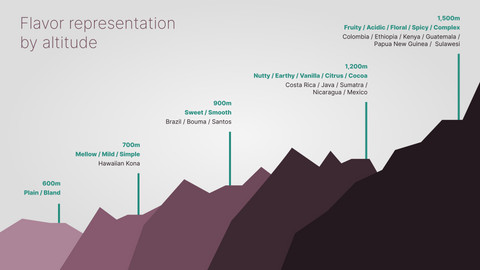
- 5000 ft /1500 m and above – the coffee in these conditions has Complex, Floral, Fruity, Acidic, and Spicy flavors. Coffee from Colombia, Ethiopia, Kenya, Guatemala, Papua New Guinea, and Sulawesi are famous for these flavor profiles.
- 4000 ft /1200 m – the coffee has Nutty, Vanilla, Cocoa, Citrus, and Earthy tasting notes. Countries like Costa Rica, Java, Sumatra, Nicaragua, and Mexico Altura produce coffee with these notes.
- 3000 ft /900 m – coffees from this altitude are usually Sweet and Smooth common to coffees from Brazil, Bouma, Santos.
- 2500 ft /700 m – the coffee is Mild, Soft, and Simple. A classic example of this is the Hawaiian Kona coffee.
- 2000 ft /600 m and below – coffees from very low elevations are typically plain and bland.
High altitude coffee countries in the world
(Coffee elevation range: 3600 – 7200 ft ( ̴ 1100 – 2200 m). Highest mountain elevation: 14,872 ft ( ̴ 4500 m)
Ethiopia is an African country located above the equator. It has an altitude that ranges between 4,232 and 14,842 feet. On the plateaus, the highest elevation is 9,843 feet, which is exceptionally high. Therefore, Ethiopia’s quality of Arabica coffee is high, and the altitude, especially at the great rift, ensures that the coffee quality stands out.
Ethiopia is the top producer of coffee in Africa and the fifth worldwide, producing about 441,000 tons (around 4 percent of the total coffee consumed worldwide). The producing areas are the western sides of Ethiopia and the central region of Addis Ababa, the capital city.
(Coffee elevation range: 2600 – 6200 ft ( ̴ 790 – 1900 m). Highest mountain elevation: 18,946 ft ( ̴ 5800 m)
Colombia has an elevation of 8284 feet and allows for the growth of various crops. Among them is coffee which maintains high quality and is very reliable in the country’s economy. Moreover, the altitude is good as it ensures that the quality of coffee from Colombia is outstanding in terms of flavor.
It is the third-highest coffee producer and accounts for 8% of the coffee in the world markets. Many people understand Colombian coffee well because of its outstanding flavor and quality. You need to know that Colombia is the world’s second-largest Arabica coffee producer.
(Coffee elevation range: 3,600 – 5,249 ft ( ̴ 1100 – 1600 m). Highest mountain elevation: 9, 416 ft ( ̴ 2900 m)
Honduras holds the 6th position after Ethiopia in the production of high-quality coffee. It ranks 5th globally and is the largest producer in Central America. Honduras supplies about 3.6 % of the world market with Arabica coffee due to its favorable climates. Areas around the west of the country are the greatest producers of coffee.
The highest altitude in Honduras is 9,416 feet above sea level, making it ideal for growing coffee. Areas that grow coffee in Honduras boast of producing the best coffee quality because the slow maturation process of the crops allows the development of desirable bean flavor and density.
(Coffee elevation range: 2,625 – 7,218 ft ( ̴ 800 – 2200 m). Highest mountain elevation: 16,762 ft ( ̴ 5100 m)
The highest point in Uganda is 16,762 ft which is too high to produce coffee. However, the country grows Arabica and Robusta coffee which is indigenous to Uganda. The two main Robusta varieties – Nerecta and Nganda – are grown at 2,625 – 4,593 ft. It accounts for 82% of Uganda’s total coffee production, especially for its suitability for the growing instant coffee industry. It mainly grows in the Lake Victoria basin to the southern region bordering Kenya, Congo, and Rwanda have Arabica coffee. On the other hand, Arabica is produced at 4,265 -7,200 ft and accounts for the remaining 18 %. Uganda accounts for 2.4% of the total world supply.
Guatemala
(Coffee elevation range: 3900 – 6200 ft ( ̴ 1200 – 1900 m). Highest mountain elevation: 13,845 ft ( ̴ 4200 m)
Guatemala scoops the 10th position in supplying coffee to the world market with 216 000 metric tons per year. It produces Arabica coffee which covers up to 97% leaving the 3% for Robusta coffee. The country, also known for its high-quality coffee, delivers 2% to the whole world market.
Coffee is grown in the southern parts of Guatemala, which has a high altitude. Its highest point has an elevation of 13,845 feet, and the lowest point is at the ocean. Most of the areas lie about 5000 ft which only favors high-quality coffee!

(Coffee elevation range: 2600 – 6500 ft ( ̴ 790 – 2000 m). Highest mountain elevation: 12,532 ft ( ̴ 3800 m)
Costa Rica is another famous country that supplies 0.88% of the global market with Arabica coffee. The coffee from Costa Rica has the best quality and flavor because of the high altitude. However, it does not produce Robusta coffee as the quality of Arabica is perfectly maintained.
The highest peaks are around 12,542 ft which is too high for coffee production. Even so, the higher elevations -particularly between 3,900 and 5,600 ft (1200 and 1,700 m)- have climates that are nicely suited to the needs of coffee plants. As a result, the coffee from Costa Rica receives high ranks in the markets.
(Coffee elevation range: 4,593 – 6,562 ft ( ̴ 1400 – 2000 m). Highest mountain elevation: 17,051 ft ( ̴ 5200 m)
Kenya produces the coffee that many drinkers deliberately love. It is valued for the complexity of its flavors, unlike any other in the world. Most coffee is grown at altitudes ranging from 4,593 to 6,562 ft on the high plateaus surrounding the snow-capped Mt. Kenya and the foothills of the Aberdare Ranges.
The central coffee-growing region spans towards the capital, Nairobi, from the 17000-foot Mt Kenya, while a smaller area lies on the hills of Mount Elgon near the border with Uganda. These areas are mountainous, and the high-altitude yields beans with desirable and prized attributes. But unfortunately, Kenya’s coffee production has significantly declined to about 39000 metric tons annually, accounting for just 0.04% of the world’s coffee.
(Highest mountain elevation: 13,435 ft ( ̴ 4100 m)
Malaysia is mountainous, with the highest mountain standing at 13,435 feet and the lowest at 3,576 feet above sea level. Therefore, it makes it one of the countries producing high-quality coffee. Commercially sound Arabica coffee is typically cultivated at an altitude of 3,281- 5,906 ft above sea level.
(Highest mountain elevation: 18,941 ft ( ̴ 5800 m)
Even so, Mexico is ranked the 9th best producer in the world. Its coffee is grown on the pacific coast and Gulf of Mexico. The country’s altitude is 18,941 feet to the highest, which is quite extreme for growing coffee.
The lowest point has an elevation of 33 feet. Under the conditions, the quality that gets produced is the best.
Exceptions at Lower Elevations
Nature provides exceptions to every rule, and coffee grown at lower elevations can still develop slowly due to other types of adversities, thereby yielding great-tasting coffee.
The two most notable exceptions are the Hawaiian Kona coffee produced below 2,000 feet and shade-grown coffee.
Downsides of high altitude
Most regions with high altitudes have mountains and valleys, presenting some of the most challenging terrains for farming and transport.
Moreover, the slower growth rate of the coffee requires more labor, longer time until harvest, and often lower yields subject to other factors. As a result, coffees produced at the highest altitudes cannot meet the current level of world coffee consumption.
Coffee has different tastes and flavors depending on its origin. Understandably, some people appreciate coffee from certain regions more because of the altitude, which considerably affects the quality and flavor of the coffee in your cup.
Even so, while high altitude is a good indication of great-tasting coffee and is certainly worth considering, it isn’t a guarantee. Many other climatic factors influence production and the handling process through the supply and value chain determines your final cup’s quality.
Nevertheless, high-altitude areas produce the best coffee quality due to the long maturation time of the crop and beans. These conditions allow the beans to develop desirable attributes, incredibly complex flavors, and bean hardness. Such environments mostly favor Arabica coffee variety, although temperature and other climatic conditions make some areas best for Robusta coffee.
Why Do Coffee Bags Mention Altitude?
But wait: Mike also mentioned altitude, but he didn’t explain why that’s important. So what does altitude have to do with your coffee’s flavour?
Well, often the higher the altitude, the sweeter the coffee is. There are exceptions to this, and the varietal and origin can also change it – for example, generally speaking the further away from the equator, the sweeter lower-altitude coffee will be. Want to know more? Colombia Coffee Hub explains it all in just 180 seconds:
SEE ALSO: Why Does Altitude Matter? A VIDEO Guide
Coffee growing altitude is a top-of-da-list factor when it comes to the flavour of your cup. Let’s check it out!

Ever heard baristas chat about high altitude coffee and liked the sound of it? It’s ‘high’, after all, and high up is the place of stars and spaceships and unicorns (they’re real). So it must be good, right?
But why? How can something like the distance from the ground alter the flavour of your coffee?
Grab your wellies and rucksack, because we’re trekking out to discover how altitude affects coffee!

How does elevation affect coffee?
Elevation is the vertical distance between sea level and the happy place where the coffee plant grows. We measure this in metres above sea level, or MASL.
If we’re being really pernickety, we should mention that there’s a slight difference between elevation and altitude (elevation refers specifically to the position of something in relation to sea level), but we can use them more or less interchangeably when chatting coffee.
So, coffee growing altitude is key when it comes to your cup. It’s a major player in determining the beans’ quality, shape, size, and flavour.

What is high elevation coffee?
What is this high elevation of which we speak? Let’s get to the numbers.
We can find coffee plants growing at very high altitudes, which is usually considered to be above 1525 metres (5000 feet). Then, (you guessed it), we find coffee growing at high altitudes of at least 1200 metres (4000 feet).
Both are a recipe for coffee success. But why?

How does altitude affect coffee?
Coffee grown at high elevations is likely to be full-flavoured and delicious. This is down to the cooler air flowing up there at 1200 metres.
And what kind of coffee growing temperatures are we talking about? A pleasant 16-23°C.

This fresh climate slows down the plants’ growing rate, giving the coffee cherry more time to mature. The natural sugars can take their time developing, too, which produces a mature bean that’s aromatic, complex and FULL of flavour.
Coffee growing altitude affects the density of the bean, too. High altitude beans are denser because the cell structure has more time to develop. Density is one of the best ways to spot high-elevation coffee: the beans will be hard, and their centre cut (the little fissure running down the middle) will be quite close together.
And the taste? Coffees grown high up above sea level often taste fabulously floral with some acidity and spice. Go a little lower, and we’ll start saying ‘hello’ to lovely notes of nut, chocolate and vanilla.

Where does coffee grown at high altitudes?
If you’re fond of your joe, you’ll know that coffee growing origin affects flavour. One reason for this is that countries offer different altitudes:
- We find very high altitude coffees growing in countries such as Columbia, Ethiopia and Kenya
- And high altitude beans? Find them in coffees from countries like Costa Rica and Nicaragua
Awesome high altitude coffees are almost always arabica. Arabica beans are premium, A-star quality; the crème de la crème of the coffee world. They can be a little more costly than robusta (their low-quality cousin) because the high altitudes which bring their standout flavour also make them harder to pick.
But a few extra pennies for fantastically flavoured and most-definitely-not-bitter beans? Totally worth it.

Does coffee grow in low altitudes?
Coffee does grow at low altitudes, but it usually lacks flavour and vibrancy. Low elevation beans will often be the robusta variety and grow at around 760 metres (2500 feet).
What are the effects of low altitude? Let’s get bullet pointing:
- Higher temperatures and less rain speed up the coffee’s maturation time
- The coffee plants grow more quickly, but don’t have enough time to develop. This makes them a bit sad (i.e. they taste dull and muddy and lack acidity).
- The yield is greater, which drives prices down. This makes robusta coffee cheaper.
- Low altitude coffees are weaker because their cell structures haven’t had enough time to grow properly. Their fissure line will gape more widely, and they’ll be softer, too. Lack of development makes them far too feeble for longer roasting. This rich, chocolatey dark roasts near impossible.
Low altitude coffee can be tasty, of course. But high attitude is what your taste buds really want!

Does altitude affect caffeine?
As a general rule, caffeine levels decrease as the altitude increases.
Conditions at low altitudes are tough. Pests, fungi and higher temperatures demand tough beans. Robusta (‘robust’) beans have adapted to these conditions by having a higher caffeine content.
Take one robusta bean. It has about 2.9 milligrams of caffeine, while an arabica one has around 1.9 milligrams. Caffeine is a natural pest repellent, so it helps the robusta plants survive the rough low altitude conditions.
The problem? That this much caffeine makes the robusta beans bitter.
There are fewer pests high up, so arabica beans don’t need that hard-hitting caffeine content. This is why arabica coffee taste so beautifully balanced with yin-and-yang sweetness!

Lots of other growing variables affect the quality of a coffee, and we can’t ignore things like soil condition and rainfall. Then there’s the roasting and brewing methods we choose: they also play a part.
But altitude will always be a big player. Grab some high altitude coffee and treat it well, because we’re pretty sure it’ll taste fantastic!
Want to learn more about the speciality coffee at Two Chimps? Find everything you need right here!
The main reason that higher elevation coffee is more sought after is the taste. When well-cared for, high elevation coffee will produce the more acidic, aromatic and flavorful cup of coffee that we love, while lower elevation coffee tends to have a lower acidity with little character in the cup. This is the real reason why your barista is telling you about the elevation of the coffee you are about to drink. Generally, a higher elevation coffee will be a better tasting coffee and by saying that the coffee was grown at 5,200’, it means the coffee should have a good flavor.
The elevation of a coffee directly impacts the flavors you can expect to find in your morning cup.Credit: DT Coffee Club
A special thanks to Rodolfo Ruffatti who contributed valuable information for this article.
Perfect Daily Grind.
Elevation has a direct impact on the size, shape and taste of the coffee you are about to consume. Now, you don’t need to demand a coffee from a certain elevation the next time you walk into a coffee shop, but understanding a little about it can help you find a coffee that you love.
In my last article about how farmers choose their coffee plant variety, we talked about how the elevation and climate of the farm can impact what type of coffee a farmer may choose to plant. To quickly summarize, arabica generally likes higher altitudes of 1,800 to 6,300’ with cooler climates, while robusta varieties prefer a lower elevation of 600 to 2,400’ with warmer climates. Within those ranges, the elevation profoundly impacts the coffee.
How Do You Know the Elevation?
Elevation impacts the physical aspect of the coffee bean. The next time you get your hands on a bag of green coffee (coffee that isn’t roasted), take a very close look at the beans. Are they small and densely formed? Is the fissure line closed, opened, straight or zig-zagged? What color are they—jade, light green or blue? All of these characteristics are affected by the elevation at which the coffee is grown.
The most sought after coffee beans are strictly hard beans (4,500’ altitude and up). These are very dense, caused partly by the slow growth that occurs in a high-altitude environment. They should have a closed fissure line that might be zig-zagged or slightly skewed. On the other hand, lower elevation coffee beans will generally be less dense, with a semi-open fissure. There will be some variation in color as the variety of coffee and beneficiary process used impacts the color. The same coffee from the same farm can have a different color in its green form if processed differently: a honey process versus a full wash. With that said, the bean density will probably be the best signal for determining the altitude of the coffee.
How to Understand Coffee Bag Labels
In this short-and-sweet clip from Epicurious, Mike Phillips of Intelligentsia Coffee explains some of the most important things to look for on coffee labels: the country and region of origin, the , the and roast profile, different certifications, and more.
As he says, this is important not just because it helps you to know the coffee quality. It also helps you to understand why you like certain coffees – and to buy similar ones in the future.
SEE ALSO: Bourbon vs Caturra: What’s a Varietal & Why Should I Care?
What Else Should I Look for on My Coffee Bag?
These videos cover the main things you’ll find on your coffee label. But once you start to get more into buying specialty coffee, you may notice some other descriptions.
refers to how the coffee bean was removed from the coffee fruit. Some types of coffee processing will give the coffee a “clean” taste, while others will add a or element.
You’ll also see coffee notes or taste profiles, which will describe things like a “chocolate aftertaste” or ““. These take a little practice to detect, but can really help you find the perfect cup for you.
This may seem like a lot of information, but once you start looking at what labels on coffee bags mean you’ll quickly realise what coffees you enjoy best. So give it a try: look at the label of your favourite coffee and work out why you like it so much – and how to discover new coffees that you’ll also love.
Feature photo credit: AirlieAce0316 via Wikimedia Commons, CC BY 3.0
Please note: Perfect Daily Grind does not own the rights to these videos and cannot be held accountable for their content.